


This article is a contribution from Jeff Farr, SVP, Sales Performance Solutions at Qualfon.
For years, outsourced sales ecosystems have operated on a familiar set of metrics: leads assigned, contact rates, conversion rates, and revenue. These numbers tell a story, but only part of the story.
They reveal what happened, but they do not explain why it happened.
As vendor networks scale and customer acquisition costs rise, organizations are being asked to optimize performance, improve ROI, and drive efficiency across increasingly complex sales channels. Yet many are still relying on reporting frameworks designed for a simpler era. Traditional frameworks lack the contextual intelligence required to make truly informed decisions.
The result? Missed opportunities, misattributed performance, and an inability to consistently identify what actually drives conversion.
The Hidden Constraint: A Data Architecture Gap
If you keep peeling back the layers of the onion, you’ll discover that the core of the issue is not a lack of data, but a lack of integration, context, and a true understanding of data orchestration.
Traditional reporting systems are built on aggregate, transactional data. They track outputs but fail to capture the underlying drivers of performance. This creates blind spots across four critical dimensions:
- Lead Context: Where did the lead come from? What are their demographics, eligibility, or prior relationship?
- Engagement Quality: How was the lead worked? What was the cadence, timing, and quality of contact attempts?
- Campaign Intelligence: What offer, channel, and spend strategy influenced the interaction?
- Vendor Strategy Visibility: How effectively did each partner execute?
Without these layers, organizations are left comparing vendors based on outcomes alone, often drawing inaccurate conclusions and optimizing in the wrong direction.
Introducing the Intelligence Layer: A New Operating Model
The next generation of sales performance isn’t about more dashboards. It’s about better intelligence in the dashboards.
Forward-thinking organizations are shifting toward a unified data framework that integrates internal data, vendor activity, and third-party enrichment into a centralized model. This approach transforms reporting into a true decision-making engine.
Instead of isolated metrics, leaders gain a multidimensional view of performance across lead intelligence, engagement intelligence, campaign intelligence, and vendor intelligence.
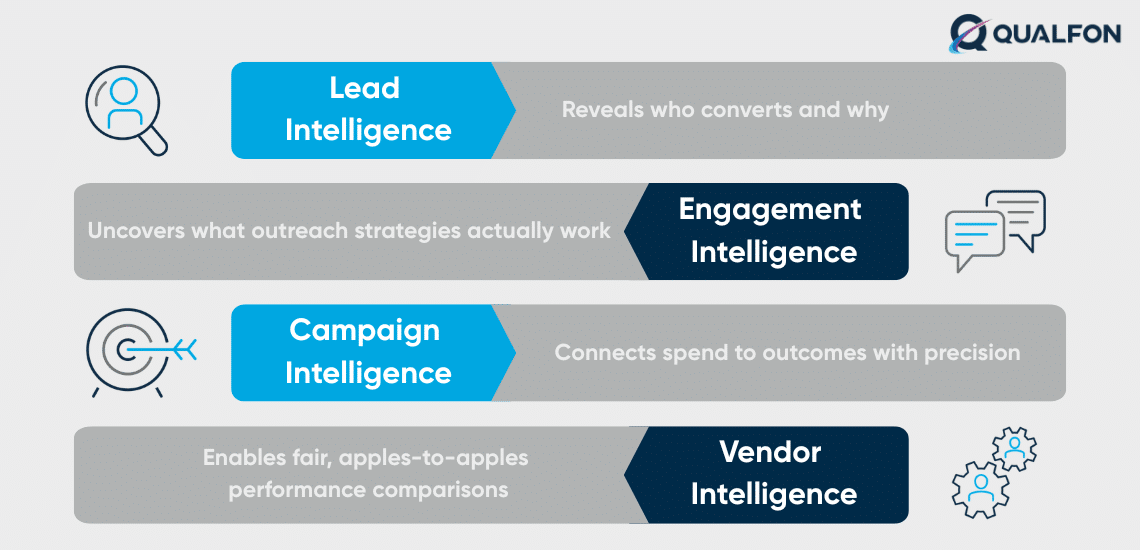
- Which vendors perform best under comparable conditions?
- What lead segments have the highest conversion propensity?
- Which outreach strategies drive the greatest ROI?
- Where should we allocate budget to maximize efficiency?
From Insight to Impact: What Next-Gen Looks Like in Practice
When this intelligence layer is operationalized, the impact is immediate and measurable.
You can expect to have:
True Vendor Performance Measurement
By standardizing data and incorporating contextual variables, organizations can finally evaluate vendors on a level playing field—factoring in lead quality, campaign mix, and execution strategy.
Smarter Targeting and Segmentation
Advanced segmentation frameworks cluster leads based on behavioral and demographic signals, enabling more precise targeting and more relevant offers. All of this equals better, more efficient marketing.
Predictive Lead Scoring
Machine learning models shift the paradigm from reactive reporting to proactive optimization, identifying which leads are most likely to convert before resources are deployed.
Continuous Optimization Loops
Every campaign becomes a learning opportunity. Performance data feeds back into the system, refining targeting, improving outreach strategies, and increasing conversion rates over time.
In this model, performance improvement is now systematic. Moving to systematic performance monitoring means a more organized, ongoing approach to tracking, analyzing, and reporting, allowing for course correction and optimization in a more timely manner.
The 90-Day Path to Transformation
A structured rollout typically follows two phases: Performance Sales Intelligence in the first 30 days, and Predictive Sales Intelligence from days 45 through 90.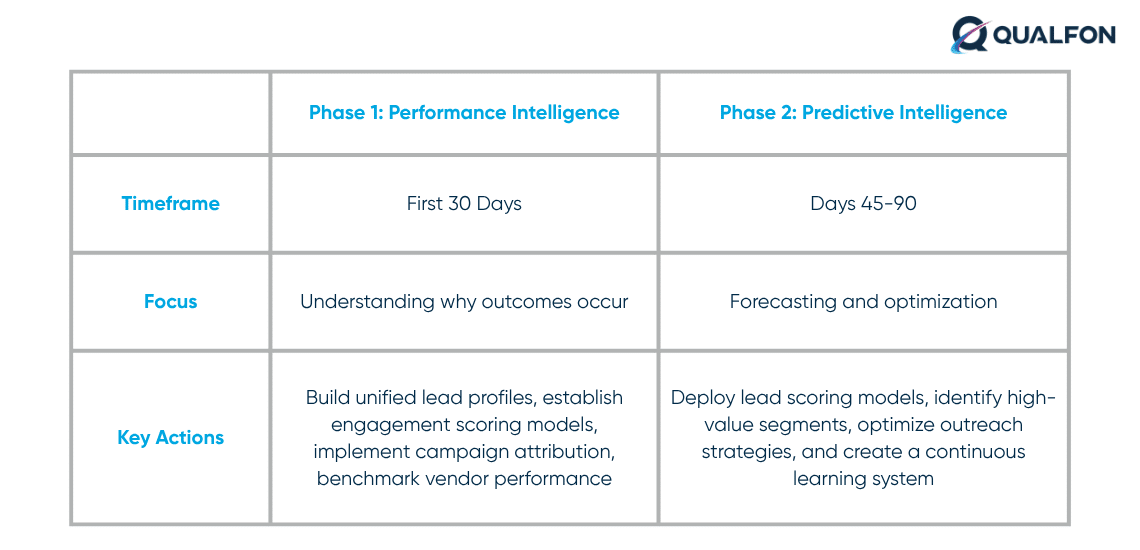
“One of the biggest misconceptions about advanced analytics is that it requires long, complex transformation cycles. In reality, meaningful progress can be achieved in a matter of months with the right approach.”
A phased approach allows organizations to quickly unlock value while building toward a more sophisticated, AI-driven operating model.
The Strategic Imperative for Leaders
The evolution from reporting to sales intelligence is not just a technical upgrade but a strategic shift in how organizations operate.
Leaders who embrace this model gain:
- Greater control over customer acquisition costs
- Increased transparency across vendor ecosystems
- The ability to scale high-performing strategies with confidence
- A durable competitive advantage rooted in data-driven decision-making
Those who don’t utilize intelligence risk falling behind by continuing to optimize based on incomplete information in an increasingly data-rich world.
Sales Intelligence Is the New Currency of Performance
The organizations that win will not be those with the most data, but those that can orchestrate their data and not only increase sales intelligence, but also the speed at which lead intelligence is shared and can be acted upon.
The future of outsourced sales performance isn’t just about generating more leads or driving more activity. It’s about building a sales intelligence engine that understands what works, predicts what will work next, and continuously improves over time.
That is the next frontier, and the opportunity is immediate.
About Qualfon
Qualfon is a global provider of omnichannel customer experience and business support solutions. From call center support to lead generation to ecommerce fulfillment, we support our clients and their customers throughout the customer journey.
Learn more about Qualfon’s Revenue Operations Solutions and Services.
About the Author
Jeff Farr is SVP of Sales Performance Solutions at Qualfon, where he leads the Revenue Generation Practice (RevOps) within the sales organization, overseeing the team behind Qualfon’s top rankings among industry analyst groups focused on revenue-centric functions including Conversational Commerce and AI Analytics.
With more than two decades of sales leadership experience at some of the top BPO companies in the industry, Jeff brings deep expertise across B2B and B2C sales, sales consulting, contact center strategy, analytics, and lead generation. His background combines strategic vision with hands-on operational knowledge of what it actually takes to build and scale revenue-generating teams.
Connect with Jeff on LinkedIn.