


This article is a contribution from Kristen Hein, Chief Client Officer at Qualfon.
Retention gets talked about as a goal, but rarely treated as the strategic priority it deserves. Far too often, I see organizations focus their energy on acquisition: new campaigns, new funnels, new leads, with the assumption that growth means adding customers. The reality is that growth depends just as much on how well you keep those customers. Customer acquisition costs have surged 222% over the last five years, making the math on retention more compelling than ever (Artisan Strategies).
What Customer Retention Actually Measures
By now, you know that customer retention rate is the percentage of customers a business keeps over a given time period. It’s calculated by taking the number of customers at the end of a period, subtracting new customers acquired, and then dividing by the initial customer count. Then multiply by 100.
Simple Calculation Formula:
- E = Customers at the end of the period
- N = Number of new customers acquired
- S = Customers at the start of the period
Example:
If you started with 500 customers (S), ended with 450 (E), and gained 50 new customers (N), you’d take 450-50=400 and 400/500=0.8. Then you’d take 0.8×100 to get 80%. The customer retention rate is 80%.
Its inverse, churn rate, is equally important to understand and measure. Churn rate measures the percentage of customers lost. And that number tends to attract far less attention than it should. An estimated 75% to 80% of revenue comes from existing customers (Bain and Company). Churn doesn’t just mean losing a subscriber or a service contract. It means losing a compounding stream of future value tied to every relationship that ends.
The Compounding Impact of Customer Churn
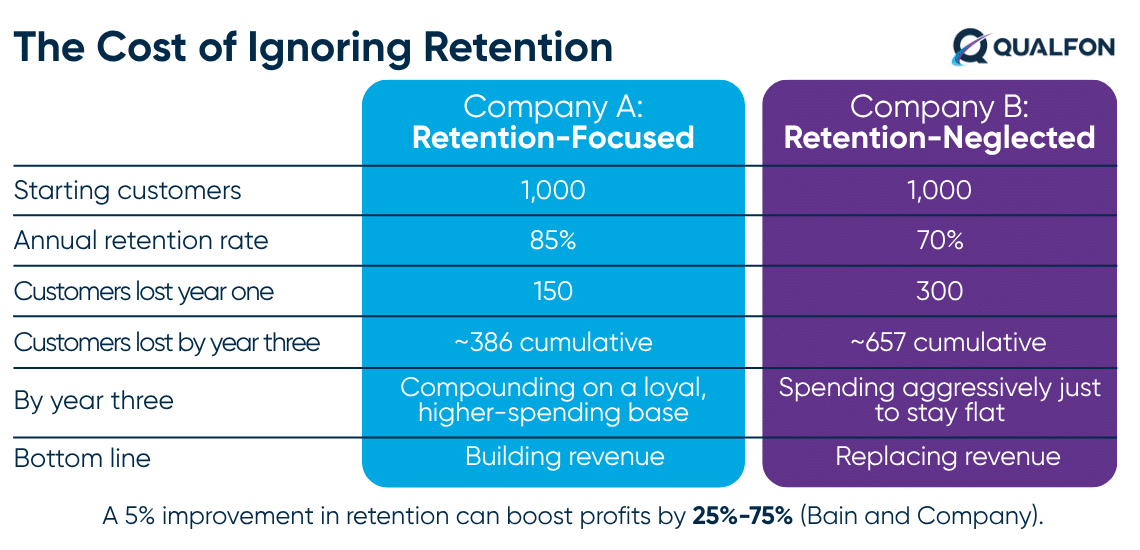
The math is unforgiving. Acquiring a new customer can cost five to seven times more than retaining an existing one (Qualtrics). The graphic below shows what that gap looks like in practice over time. A 5% improvement in retention can boost profits by 25 to 75% (Bain and Company). Small retention gains deliver outsized returns because retained customers spend more, cost less to serve, and refer others in ways that reduce acquisition costs elsewhere.
What Churn Is Actually Telling You
Churn is a symptom before it’s a statistic. When customers leave, they’re communicating something about their experience – whether they felt valued, whether their issues got resolved, whether the service delivered on what was promised.
Most churn doesn’t trace back to product failures. It traces back to operational ones. Poor onboarding, weak relationship-building, and service interactions that left customers feeling unheard account for the majority of preventable losses. In financial services, where customers already expect precision and reliability, poor digital experiences and competitive alternatives drive a 19% annual churn rate (CustomerGauge). These aren’t product problems. They’re service delivery problems.
That’s exactly what Qualfon found when working with a major telecommunications provider. After analyzing cancellation call data, the team discovered that 62% of cancellations involved controllable, recoverable situations. Associates had the will to save accounts but lacked clear scripts, objection-handling techniques, and consistent offer strategies. Targeted coaching and structured training drove a 160% improvement in save rate in just four months.
The Operational Factors That Move Customer Retention
If most churn traces back to service delivery, retention improvement is largely an operational challenge. The businesses that win on retention treat the contact center not as a cost center but as a revenue protection function.
A few factors consistently make the difference. First-contact resolution matters more than almost anything else — customers who get their issue resolved on the first call don’t need a reason to reconsider. Channel consistency is equally critical. When customers have to repeat themselves across touchpoints or receive conflicting information, trust erodes fast. And associate skill sits at the center of both. The confidence, training, and tools available to the person handling a call shape the outcome of that call, and by extension, whether that customer renews.
I recently wrote a piece on experience orchestration, and in that blog post, I talked about how retention isn’t about satisfaction alone. It’s about consistently earning confidence, especially in the moments that matter most to customers.
Organizations that put customers at the center of their business decisions report 41% faster revenue growth, 49% faster profit growth, and 51% better customer retention than their competitors (Forrester). The contact center is where that commitment either shows up or falls short.
About Qualfon
Qualfon is a global provider of omnichannel customer experience and business support solutions. From call center support to lead generation to ecommerce fulfillment, we support our clients and their customers throughout the customer journey.
Learn more about Qualfon’s Call Center Support, Customer Experience Solutions, and Back Office Support Services.
About the Author
Kristen Hein is Chief Client Officer at Qualfon, where she leads strategic growth and client engagement across the Banking, Financial Services & Insurance, and Healthcare verticals. With more than 25 years in customer experience, global delivery, and revenue leadership, she has partnered with Fortune 100 organizations to scale AI-enabled, compliance-ready CX operations that drive retention and enterprise value.
Kristen is known for building high-performing global teams, strengthening executive relationships, and transforming contact centers into engines of trust, loyalty, and measurable business outcomes—guided by a deep commitment to human-centered innovation and operational rigor in highly regulated environments.
Connect with Kristen on LinkedIn.
Sources:
Artisan Strategies, “Customer Acquisition vs. Retention Costs: Statistics and Trends,” 2025
Bain and Company, “Prescription for Cutting Costs”
CustomerGauge, “State of B2B Account Experience”
Forrester, “2024 US Customer Experience Index”
Qualtrics, “30 Statistics About Customer Churn,” 2025