


This article is a contribution from Graylon Perkins, VP of Performance Marketing at Qualfon.
Every Medicare organization eventually hits the same wall: leads are coming in, agents are busy, and activity is high.
But revenue? Flat.
So the instinct is predictable. You assume you need more leads.
The truth is, in Medicare, more leads rarely fix performance problems.
The Economics of “Bad” Leads
On paper, most Medicare lead programs look viable. Leads cost anywhere from $50-$150 each and close rates typically land around 10-15%.
The math should work, but in practice, it often doesn’t.
Let’s look at a common scenario:
- $5,000 in spend
- 50 leads purchased
- 5-8 policies closed
The result is a loss of $1,800–$3,000.
This is the hidden reality of low-quality lead generation: you can be “busy” and still unprofitable.
The Problem Isn’t Volume. It’s Intent.
Intent is the key differentiator, and not all leads represent the same level of intent.
If you think about a shared web form lead, a cold outbound list, or a consumer-initiated inbound call, you know the difference and it’s not subtle. It’s actually structural.
High-intent models (like inbound calls or pre-educated prospects) consistently outperform because:
- The consumer is actively seeking help
- Trust is already established
- Timing is aligned with decision-making
In some cases, high-quality, pre-qualified leads can convert 2–3x higher than standard models.
That’s not a marginal improvement. That’s the difference between scaling profitably and not scaling at all.
Where Low-Quality Leads Actually Hurt You
Most organizations underestimate how much damage poor lead quality causes. It’s not just about conversion. It’s about system-wide inefficiency.
1. Agent Time Gets Wasted
Every low-quality lead creates hidden cost: multiple dial attempts, follow-ups over weeks, and dead-end conversations. Medicare sales cycles already require 5–10 touchpoints over 30–90 days. When the lead lacks intent, that effort compounds into waste.
2. ROI Becomes Unpredictable
Low-quality leads distort your metrics. Contact rates look fine, activity levels look strong, but close rates lag. This is when you buy more leads, not realizing you’re just compounding the problem.
3. Compliance Risk Increases
Medicare is one of the most tightly regulated marketing environments in any industry. Violations can result in civil monetary penalties reaching up to $100,000 per incident. Low-quality leads often come with weak or unclear consent, poor documentation, and questionable sourcing — which means you’re not just risking performance, you’re risking your business.
4. Customer Experience Breaks Down
Medicare beneficiaries are not casual shoppers. Every day, ~11,000 Americans turn 65, entering a complex, high-stakes decision process. When they experience repeated calls from multiple agents, irrelevant outreach, and poor timing, trust erodes quickly.
5. Retention and Lifetime Value Decline
This is where the real damage happens. Policies driven by low-intent leads tend to churn faster, switch during AEP, and deliver lower lifetime value. Meanwhile, higher-quality interactions (especially calls) are tied to 28% higher retention rates.
"Lead quality doesn't impact acquisition—it defines long-term profitability."
Why the Industry Still Defaults to Volume
Despite all of this, most conversations still revolve around cost per lead, lead counts, and speed of delivery.
Why? Because volume is easy to measure and quality isn’t. Quality requires closed-loop reporting, source-level attribution, and longitudinal performance tracking, and many organizations optimize for what’s visible instead of what’s valuable.
What High-Quality Medicare Lead Generation Actually Looks Like
The best-performing organizations don’t just buy leads differently. They evaluate them differently. Rather than optimizing for volume and cost per lead, they build their entire acquisition strategy around five standards that drive sustainable, profitable growth.
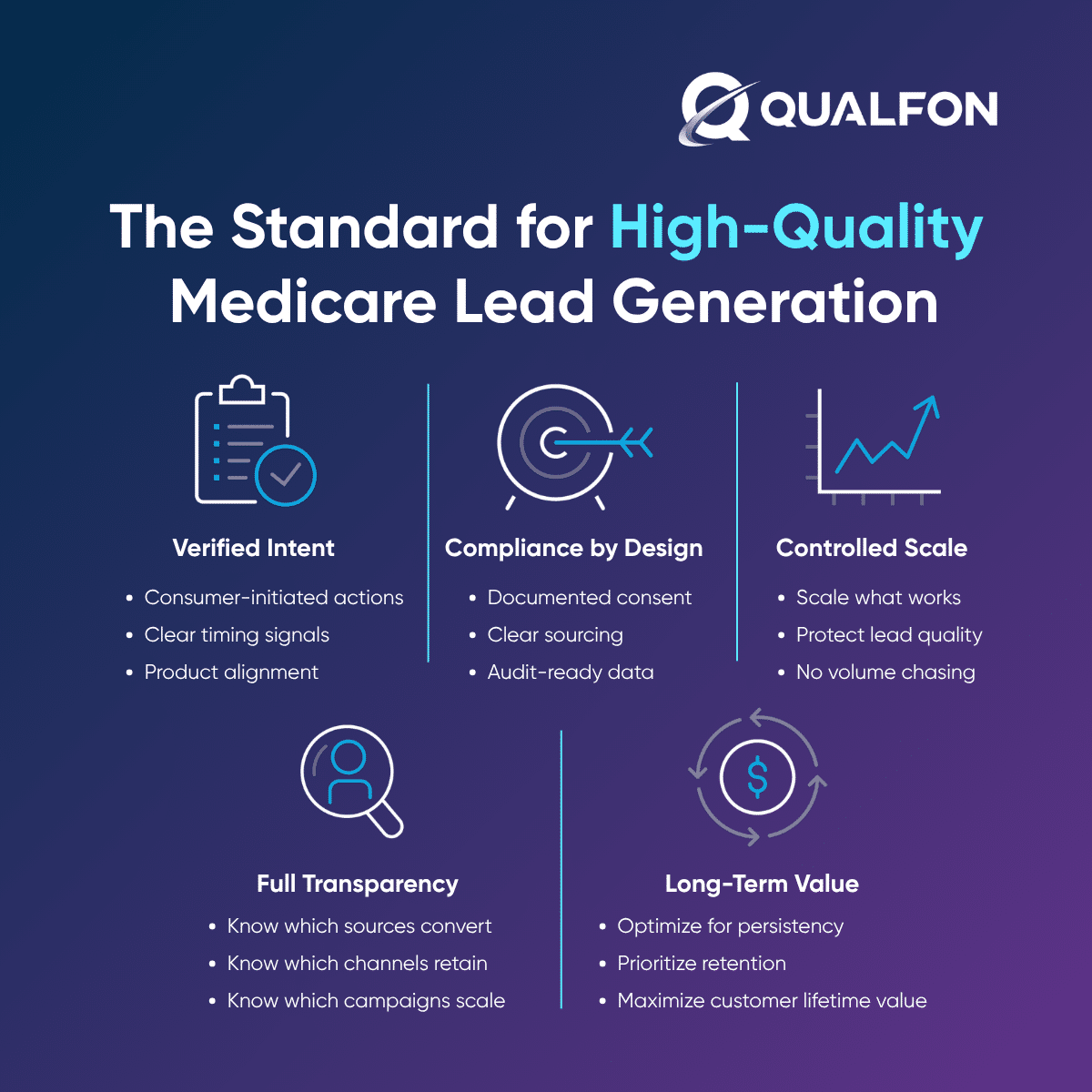
The difference between organizations that scale profitably and those that stay stuck often comes down to whether these standards are treated as a checklist or as the actual foundation of their lead strategy.
The Shift That Changes Everything
The highest-performing Medicare organizations make one critical shift:
They stop asking, “How do we get more leads?” and start asking, “How do we get more from the right leads?”
Because when quality improves:
- Conversion rates increase
- Agent efficiency improves
- Compliance risk decreases
- ROI becomes predictable
In Medicare, every lead carries weight.
It might be a higher cost, more risk, or deliver more of an impact on long-term value.
That’s why quality isn’t a luxury; it’s the foundation, and in a market where anyone can generate leads, the real advantage belongs to those who generate the right ones.
About Qualfon
Qualfon is a global BPO provider of omnichannel customer experience and business support solutions with locations on several continents. We are an agile partner specializing in call center support, revenue growth, and marketing services committed to serving our clients and their customers throughout the customer journey.
Learn more about Qualfon’s Lead Generation and Direct Mail & Print Services.
About the Author
Graylon Perkins is Vice President of Operations, Performance Marketing at Qualfon, where he oversees lead-generation operations across both digital and traditional channels, including mail, email, social, search, and programmatic media. His work focuses on scaling performance, improving efficiency, and ensuring consistent execution across complex, multi-channel programs.
Before joining Qualfon, Graylon spent more than a decade as an insurance agency owner and operator, leading sales teams and managing nationwide operations across property, casualty, life, and health markets. Based in Daytona Beach, Florida, he brings an operator’s perspective to the same growth and customer-experience challenges faced by Qualfon’s clients and partners.
Connect with Graylon on LinkedIn.
