


This article is a contribution from Galina Petrenko, VP of Data, Analytics, and AI at Qualfon.
Many organizations have spent hundreds of thousands of dollars on a lead generation campaign only to find that a significant portion of the people who received it were unlikely to respond. The campaign launches, response rates fall short, and the natural reaction is to spend more, mail more, and reach more people. But the real problem usually isn’t reach, it’s targeting.
Too often, marketing dollars go toward prospects who were unlikely to convert from the start. Predictive modeling changes that before a campaign launches, not after it underperforms. By analyzing existing customer data, it identifies the prospects most likely to respond, helping organizations focus their budget and outreach where they can generate the greatest return. The result is lower marketing spend, higher response rates, and reduced customer acquisition costs.
What Predictive Modeling Actually Is
Predictive modeling is a data-driven process that uses existing customer information to forecast which prospects are most likely to take a desired action, whether that’s responding to a mail piece, requesting a quote, or enrolling in a plan.
It works by analyzing the characteristics of your existing customers, the ones who actually converted, and identifying what they have in common. Those patterns are then applied to a prospecting universe, assigning each record a propensity score that reflects its likelihood of responding.
The result is a ranked audience. High-propensity prospects stay in the campaign. Low-probability records get removed before production begins.
Consider a Medicare insurer looking to improve the performance of its acquisition campaigns. By analyzing data from 50,000 existing policyholders, the organization discovers that its highest-converting customers share several characteristics:
- Recently retired or approaching retirement
- Living in specific geographic markets
- Engaging with educational healthcare content
- Demonstrating prior interest in healthcare-related offers
A predictive model uses those insights to identify and rank similar prospects across a much larger audience based on their likelihood to respond. Instead of mailing one million households, the insurer can confidently focus on the 400,000 prospects most likely to engage, reducing marketing spend, improving response rates, and lowering the overall cost of customer acquisition.
Why Traditional Segmentation Is No Longer Enough
Many organizations still rely on broad segmentation based on age, income, geography, or household characteristics. Those variables remain useful, but they often fail to answer the most important question: which individual prospect is most likely to convert?
Two people can fall into the same demographic segment while their likelihood of responding differs significantly. Rather than targeting a category of people, predictive models evaluate the probability that a specific individual will respond, drawing on thousands of data points and behavioral signals. That shift from demographic assumptions to probability-based decision-making is what drives meaningful improvements in campaign performance.
How AI Is Making Predictive Modeling More Powerful
The biggest misconception about AI lead generation is that it replaces marketing expertise, when in reality it amplifies it.
Advances in artificial intelligence and machine learning have significantly expanded what predictive modeling can do. Modern models evaluate thousands of variables simultaneously, uncovering relationships that would be difficult for analysts to identify manually. Rather than relying on static segmentation rules, AI-powered models continuously learn from new campaign performance data, helping organizations refine targeting over time and improve marketing efficiency with each campaign.
Technology surfaces the patterns, but business context still determines which outcomes matter, which customer segments generate long-term value, and how analytical insights translate into marketing decisions. The organizations seeing the strongest results combine AI-powered modeling with deep domain expertise, operational execution, and continuous performance measurement.
What It Does to Spend and Results
The conventional approach to lead generation treats the mailing universe as relatively fixed. You reach as many prospects as the budget allows and optimize from there. Predictive modeling inverts that logic. Budget concentrates on prospects most likely to respond, and stops going toward those who aren’t.
Companies implementing predictive lead scoring report a 40% improvement in lead-to-purchase conversion rates, driven by better prioritization, ensuring high-potential prospects receive appropriate attention (Leadgen-Economy). Salesforce research covering more than 5,000 marketing organizations found that companies using AI-powered lead generation see an average 73% increase in qualified leads within six months (Salesforce).
The math compounds quickly. Fewer low-probability contacts mean lower production and postage costs. Higher response rates from a better-targeted audience mean lower cost per lead. And leads modeled to convert tend to close at higher rates, driving cost per acquisition down further.
Qualfon applied this to a healthcare insurance lead generation and age-in campaign, eliminating low-probability prospects from the mailing before a single piece was printed. In one campaign, targeting work improved lead generation response by 200%, age-in response by 700%, and saved $600,000 in production and postage costs.
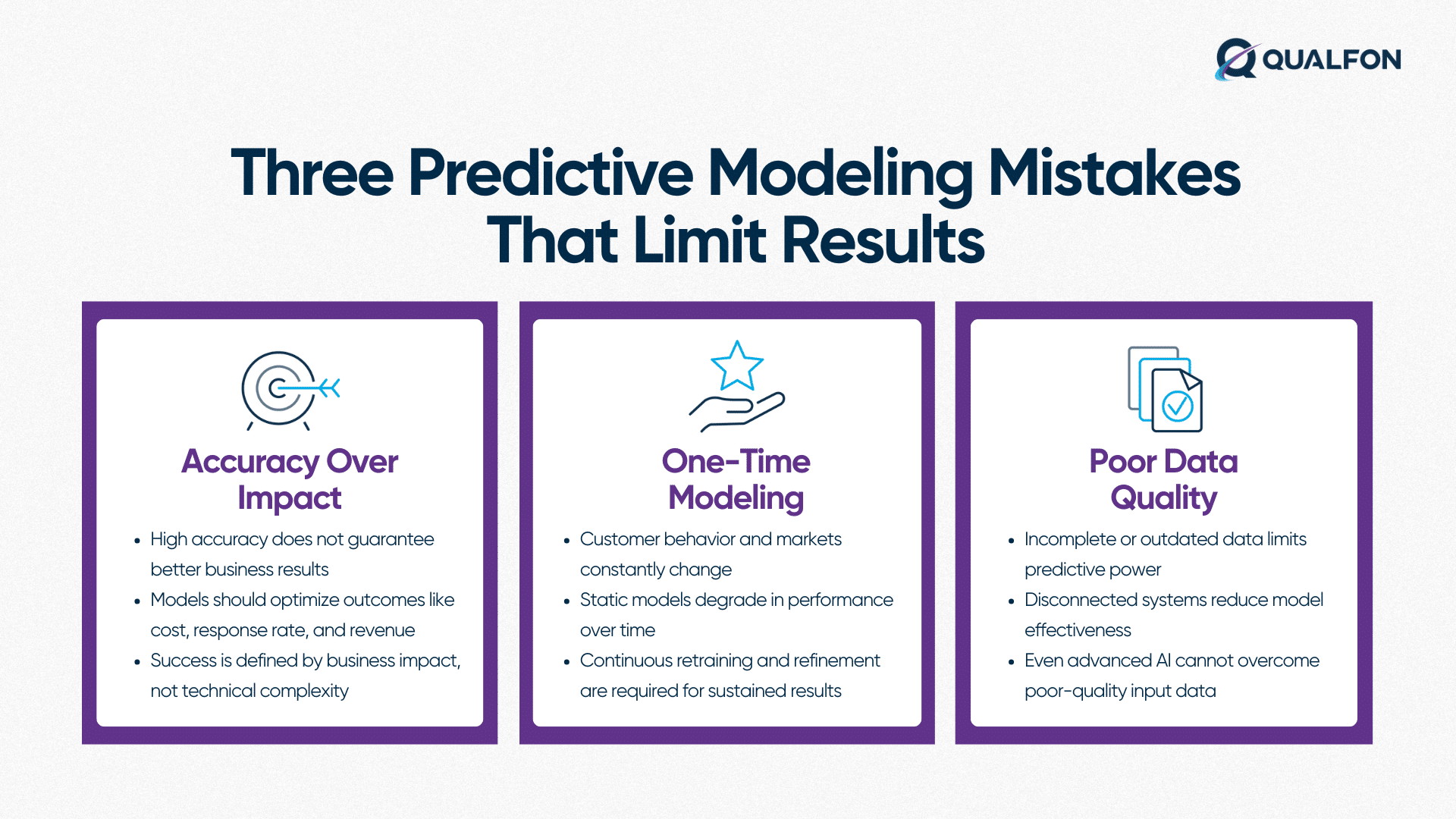
Three Predictive Modeling Mistakes That Limit Results
After years of building and deploying predictive models across customer acquisition programs, the same three mistakes consistently surface.
- Focusing on model accuracy instead of business outcomes. A model can achieve impressive statistical accuracy and still fail to improve business performance. The real objective isn’t building the most sophisticated model possible; it’s reducing acquisition costs, improving response rates, and increasing revenue. The best models get measured by business impact, not technical complexity.
- Treating predictive modeling as a one-time project. Customer behavior changes, markets shift, and competitive dynamics evolve. Organizations that build a model once and leave it unchanged tend to see performance deteriorate over time. The highest-performing programs continuously retrain and refine models using campaign response data to maintain effectiveness.
- Underestimating data quality. Incomplete customer records, outdated information, and disconnected data sources often limit predictive performance more than the modeling methodology itself, and even the most advanced AI models cannot compensate for poor underlying data.
Where the Data Comes From
Predictive modeling is only as good as the data behind it. The strongest models combine first-party customer information with third-party demographic, behavioral, and geographic data that expands visibility into prospect characteristics.
Depending on the campaign, that can include customer purchase history, response history, geographic information, household demographics, life-stage indicators, digital engagement signals, and third-party consumer data. The more accurately the data reflects actual customer behavior, the more effectively the model can predict future outcomes.
The model learns from your actual customers, not from industry averages or assumed personas. That’s what separates predictive modeling from basic demographic segmentation. One targets a category of people, while the other scores an individual within that category, and that’s what makes the predictions more precise and more actionable.
Personalization Makes the Targeting Work Harder
Reaching the right prospect is the first half of the equation. What you say when you reach them matters too.
Variable data printing makes it possible to carry recipient-specific messaging, offers, and imagery into every piece at campaign scale. The personalization isn’t cosmetic. It’s what converts a well-targeted prospect into a response.
For a warranty client, Qualfon built a direct mail program that triggered personalized outreach based on specific customer events, like a service visit or a price concern. That timing and relevance drove a 46% improvement in response rate and $1.5M in incremental sales. An automotive dealer program applying the same combination at volume moved incremental sales from 0.5% to 7%, producing 20 million pieces annually with 90% dealer participation.
The Upstream Shift
What predictive modeling ultimately represents is a shift in where optimization happens. Most programs optimize after the campaign runs, adjusting based on what response data shows. Predictive modeling moves that to the targeting decision, before spend is committed and production begins.
As acquisition costs continue to rise, the ability to make smarter targeting decisions before committing budget is becoming one of the most important advantages in lead generation. Reducing cost per lead after a campaign runs means cutting the spend that has already gone out. Reducing it before means never spending it on the wrong audience in the first place. The future of lead generation isn’t broader reach, it’s greater precision.
About Qualfon
Qualfon is a global provider of omnichannel customer experience and business support solutions. From call center support to lead generation to ecommerce fulfillment, we support our clients and their customers throughout the customer journey.
Learn more about Qualfon’s Lead Generation Services, Direct Mail Marketing Services, and Customer Data Platform Solution.
About the Author
Galina Petrenko is Vice President of Data, Analytics, and AI at Qualfon, where she leads initiatives that transform data into actionable insights and AI-driven intelligence, helping clients and business leaders make smarter decisions, optimize performance, and drive growth. She partners with executive teams to leverage predictive analytics, artificial intelligence, and customer intelligence to improve customer acquisition, retention, experience, and revenue growth.
With more than 20 years of experience in data strategy, marketing analytics, customer intelligence, and digital transformation, Galina helps organizations move beyond traditional reporting to predictive, insight-driven decision-making that accelerates growth, innovation, and competitive advantage.
Connect with Galina on LinkedIn.
Sources:
Salesforce, “State of Marketing,” 2024
Leadgen-Economy, “Predictive Analytics in Lead Generation: The Complete 2026 Guide,” 2026
