



This article is a contribution from Marvie Wright, VP, Learning & Development at Qualfon.
Every organization eventually faces the same moment: the training program that once worked no longer fits the business. Roles have changed, skill gaps have widened, and the curriculum built two or three years ago is quietly costing more than it’s teaching. The instinct is often to fix it in-house, but that is a decision that could end up costing an organization in the long run.
You may have been in this scenario before…a selected subject matter expert updates a few slides, a manager reorders some modules, and the training program is considered updated. It’s a fast fix but it’s rarely the right decision.
Curriculum redesign is not a content problem. It’s a systems problem. An instructional design team doesn’t just refresh material; it analyzes how people learn, where performance breaks down, and which instructional strategies close that gap fastest. That distinction is the difference between a training update and a training investment.
I’ll say that again to make the point. There is a difference between a training update and a training investment. Be sure you know what is needed before deciding which path to take.
The Business Case
Well-designed curricula shorten time-to-competency, which means new hires and employees that are regularly upskilling reach full productivity faster. They reduce costly rework, because content built on a needs analysis targets the actual performance gap. Well-designed curricula are also scalable — a program designed with sound instructional principles adapts to new roles, tools, and delivery formats without being rebuilt from scratch every time.
The Risk of Going It Alone
DIY redesigns tend to pile on more content rather than better content. That is a mistake I see often, but volume should never be prioritized over value. More material does not mean a better training program. A structured needs analysis is crucial, and without it, teams often solve the wrong problem entirely — polishing modules that were never the source of the performance gap. Next are instructional design principles, which are necessary to guide structure, sequencing, and assessment.
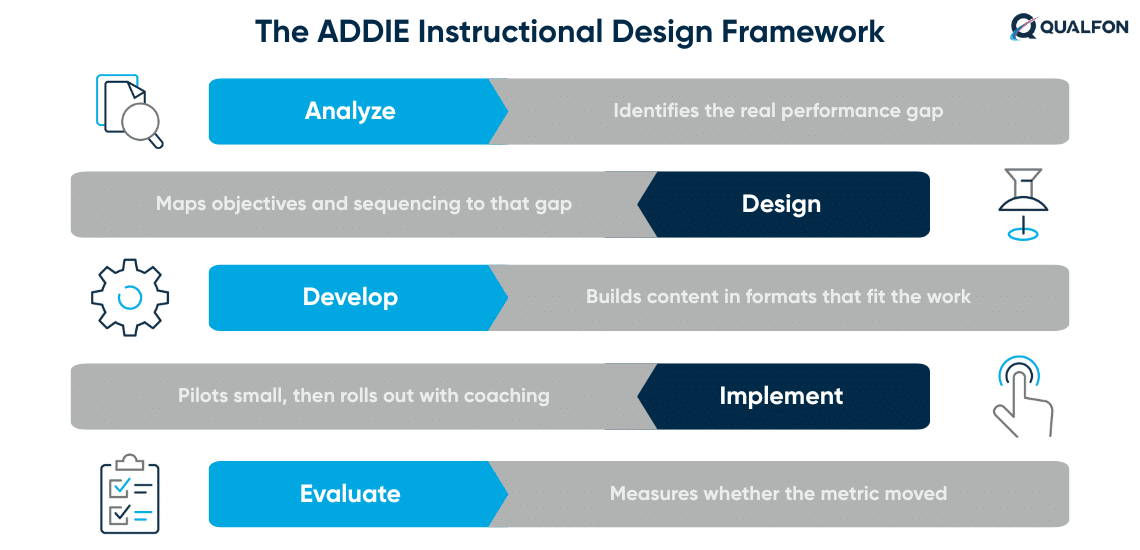
The instructional design process typically follows a structured cycle rather than jumping straight to content creation — the ADDIE model. It starts with Analysis: identifying the actual performance gap, whether that’s rising handle times, inconsistent CSAT, or a new program with no formal training yet. From there, Design maps learning objectives to those specific gaps and architects the curriculum — sequencing, delivery format, and assessment strategy — before a single slide gets built.
Development follows, with formats chosen for how the content will actually be used (self-paced modules, live coaching, job aids, simulations). Implementation is next: a pilot with a small group to catch what doesn’t land before a full rollout. The final stage, Evaluation, is where most DIY redesigns fall short — measuring whether the training actually moved the metric it was built to fix and feeding that back into the next revision.
The Solution
A curriculum shaped by instructional design expertise is built around how people retain and apply information, not just how information can be delivered. That means clearer paths to mastery, assessments that measure competency, and content that respects a learner’s time instead of padding a course catalog.
This is the conversation worth having with every client staring down a stale curriculum or an underperforming training program. They don’t need more content. They need a redesign grounded in analysis, built by people who understand how learning works.
About Qualfon
Qualfon is a global BPO provider of omnichannel customer experience and business support solutions with locations on several continents. We are an agile partner specializing in call center support, revenue growth, and marketing services committed to serving our clients and their customers throughout the customer journey.
Learn more about Qualfon’s Call Center Support, CX Innovation, and Back Office Support Services.
About the Author
Marvie Wright is a visionary learning executive and transformation leader with a passion for turning potential into performance. With over 10 years at Qualfon, she leads training, learning specialists, instructional design (including AI), SMEs, and admin teams—building ecosystems where innovation and excellence thrive.
Her accolades include 2021 Shining Star, Six Sigma Green Belt, John Maxwell Certified Coach & Trainer, and active membership in the executive network Chief. Recognized globally for impact, Marvie was named Analyst of the Year (CallMiner, 2018) for groundbreaking speech analytics innovation, and in 2025, her team earned Top 10 L&D Departments in the World (OnCon).
Known for her energy, clarity, and bold vision, Marvie is a powerful force at any table where learning, leadership, and innovation are on the menu.
Connect with Marvie on LinkedIn.
