


Overview
A cybersecurity software provider was losing time and customer confidence on one of its most common call types. Account update requests made up 34% of all call volume, but the process was tangled with repeated IVR (interactive voice response) transfers, unclear agent guidance, and no standardized script. The result was ballooning Average Handle Time (AHT) and customers who had to re-explain their issues multiple times just to get basic help.
Qualfon’s Quality Analytics and Insights team identified the opportunity before the client had to ask and delivered results within four weeks.
The Challenge
Account update requests were the single largest call driver, accounting for one in three calls handled. Despite the volume, the process had no standardized script, and associates were navigating calls without clear upfront instructions. When they got stuck, calls were routed through repeated IVR transfers, compounding handle time and frustrating customers who were already reaching out to fix something.
The numbers told the story. AHT sat at 1,137 seconds (nearly 19 minutes) for a call type that should have been routine. High AHT is rarely just a training problem — it usually signals a process problem underneath, as Qualfon has seen across other programs where handle time improvements required rethinking the tools and workflows associates relied on. Here, customers were making multiple requests within the same interaction, system errors were disrupting calls regularly, and quality errors tied to account update handling were consistent week over week.
Without intervention, the pressure would only grow. Higher call volume meant more inefficiency, more labor cost, and more customers leaving interactions unsatisfied.
Our Approach
Qualfon’s Quality Analytics and Insights team brought the analysis to the client before it escalated. Using Six Sigma methodologies, the team mapped what was actually happening on these calls and where the process broke down.
What the analysis revealed:
- Associates lacked upfront instructions to guide customers through account updates efficiently
- Repeated IVR transfers were creating rework loops instead of first-contact resolutions
- Script inconsistency meant some associates handled the call type well while others struggled, with no way to standardize across the team
Workflow mapping gave the team a clear picture of the current state versus what the process should look like. From there, they designed a new agent script tailored specifically to account update requests, got client approval before rollout, and built the monitoring infrastructure to make the changes stick.
Implementation Excellence
The rollout moved from analysis to action in under two months. Root cause analysis and solution development wrapped in July 2025. The client-approved script went live in August, with Quality Analytics and Insights, Operations, Learning and Development, and the client all working in close alignment throughout.
From there, the team tracked script utilization, AHT trends, and quality error counts every week, creating a fast feedback loop that kept findings, coaching priorities, and operational adjustments moving in the same direction.
One challenge remained throughout: non-tech-savvy customers still required more handling time despite the process improvements. The team accounted for this in how they evaluated and interpreted the data.
Results
Results were measured over four weeks (August 3 – August 24, 2025):
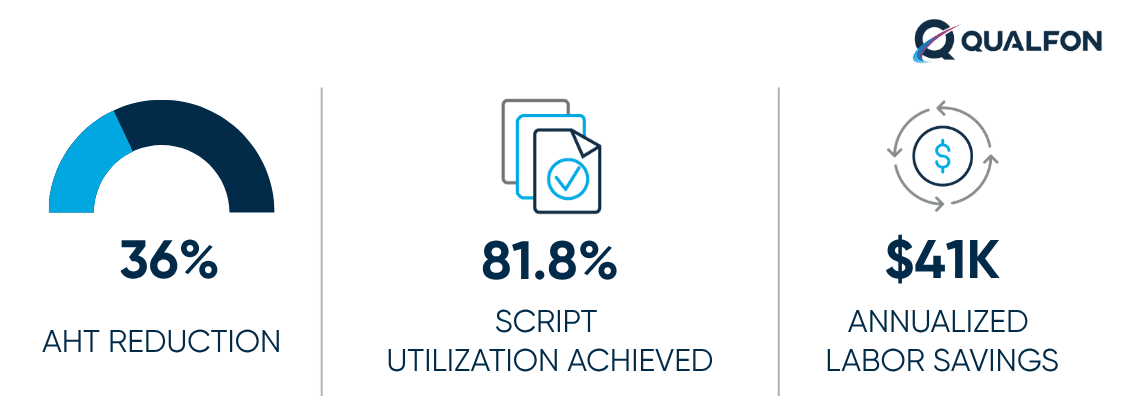
Script Utilization: Grew from 59.1% to 81.8% in under three weeks, reflecting how quickly associates adopted the new process when given clear, structured guidance.
Quality Errors: Fell from 11 to 4, indicating more accurate, consistent call handling across the team.
Customer Impact: Customers saved approximately 15 minutes per interaction by eliminating rework and repeated transfers. Instances of customers needing to repeat themselves and system errors disrupting calls both declined week over week.
Cost Impact: Equivalent to $9,000 in monthly labor savings, or approximately $41,000 annualized, a direct result of reducing handle time on the program’s highest-volume call type.
Promoter calls, defined as interactions where no customer-side issues arose, held steady at six to nine weekly throughout the measurement period, confirming that efficiency gains did not come at the expense of customer experience quality.
Beyond the Numbers
"The QA team made a meaningful impact: from analyzing call types — at the time of the discussion, one third of all handled calls were account-update related — to creating a script and closely monitoring AHT opportunities through quality audits so we could act on the findings. Thanks to the continued monitoring of this parameter within QA evaluations, in the second part of the year, we achieved stable AHT performance, meeting the target from July 2025 onwards."-Quality Partner, Cybersecurity Software Provider
Three factors made the results sustainable, not just fast.
Monitoring frequency matters. Weekly tracking of script utilization and AHT created accountability loops that monthly reviews never would have caught in time. When something shifted, the team knew within days.
Process adoption has to be measured, not assumed. The script only drove results because script utilization was tracked actively. Adoption and adherence were treated as performance metrics, not implementation checkboxes.
Knowledge gaps and efficiency gaps are often the same problem. Most AHT outliers trace back to associate knowledge issues. Targeted coaching on those specific gaps, informed by quality audit data, addressed root causes rather than symptoms.
Qualfon also introduced AHT-specific quality audit parameters that the client has since adopted program-wide across their servicing partners, expanding the impact of the initiative beyond the original team.
The same principles apply regardless of industry or call type. When process gaps drive handle time up, fixing the surface behavior without addressing the underlying workflow rarely holds. It’s an approach that has driven results in communication-driven CX improvements across other Qualfon programs as well.
About Qualfon
Qualfon is a global provider of omnichannel customer experience and business support solutions. From call center support to lead generation to ecommerce fulfillment, we support our clients and their customers throughout the customer journey.
Learn more about Qualfon’s Call Center Support, Customer Experience Solutions, and Back Office Support Services.
Cutting Direct Mail Costs by 15% for an Automotive Marketing Appreciation Program
A global marketing and advertising technology agency needed a fulfillment partner for a monthly customer appreciation program on behalf of a major U.S. automotive manufacturer. Each new car buyer receives a paint pen matched to the exact color of their vehicle, packaged with a branded letter and a coupon for service at their dealership. Qualfon designed and managed the entire operation from a single location, delivering zero-defect production through the program's first two monthly mailings while reducing execution costs by 15%.
Read More