


These two terms appear constantly in logistics conversations, often as if they mean the same thing. They do not. Fulfillment centers and distribution centers serve different customers, handle inventory differently, and require entirely different operations. Choosing the wrong model, or working with a partner who only supports one, creates gaps in your supply chain that show up as delayed orders, misrouted freight, and missed service commitments.
Here is what each one actually does, how they compare, and when a brand needs both.
A Distribution Center Moves Product in Bulk
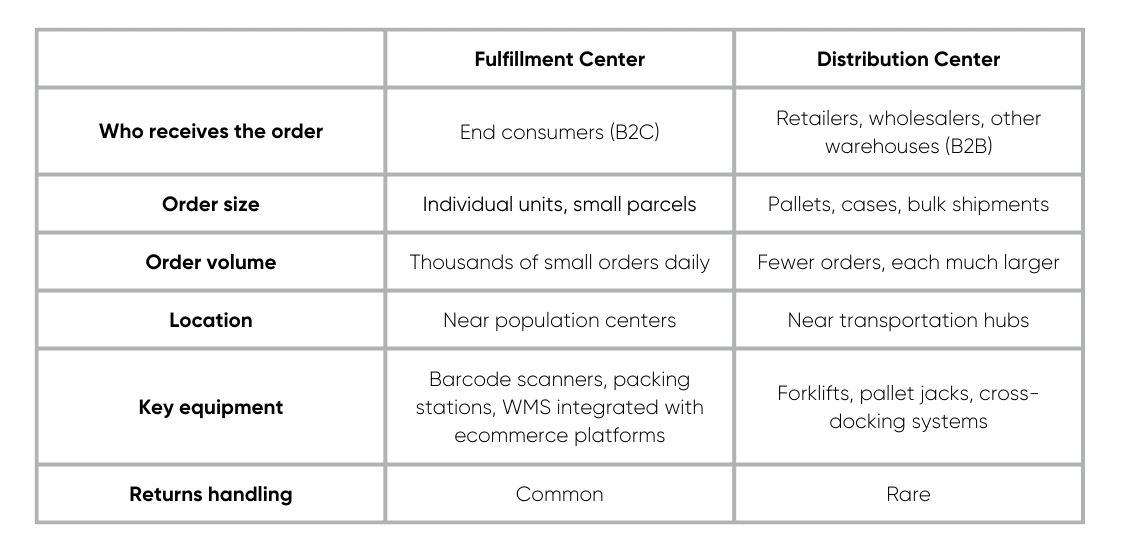
A distribution center serves as a regional hub, receiving large inbound shipments from manufacturers or suppliers and redistributing them to retail stores, wholesalers, or other warehouses. The end recipients are businesses, not consumers. Orders leaving a distribution center are typically measured in pallets and cases, not individual units.
These facilities sit near transportation infrastructure: major highways, rail lines, ports, and air cargo facilities. Speed at the individual order level matters less here than throughput, freight consolidation, and cost per unit shipped.
A Fulfillment Center Ships Directly to Customers
A fulfillment center processes individual consumer orders. When a customer purchases something from an online store, a fulfillment center handles the entire sequence: receiving the inventory, storing it, picking each item, packing the order, and shipping it to the customer’s door.
Fulfillment centers sit near population centers because last-mile proximity drives delivery speed. They run a high volume of small, discrete orders simultaneously and rely on barcode scanners, labeling machines, packing stations, and warehouse management software connected directly to a brand’s order management platform.
The scale of demand shaping this model is significant. The global ecommerce fulfillment services market reached $140.1 billion in 2025 and is projected to exceed $272 billion by 2030, according to Capital One Shopping research.
How They Stack Up
When Your Business Needs Both
Many brands selling through multiple channels need both models running in parallel. A consumer goods brand might sell directly to shoppers through its own website, fulfill orders through Fulfilled by Amazon (FBA), and supply products to retail partners, all at the same time. Those channels require different infrastructure, and treating them the same way creates problems fast.
The direct-to-consumer and Amazon channel needs a fulfillment center: individual order processing, fast turnaround, consumer-facing packaging, and Amazon prep compliance for FBA inventory. The retail wholesale channel needs a distribution center: pallet-level compliance, bulk shipping to store networks, and freight consolidation. Forcing one model to handle both creates bottlenecks and compliance failures on whichever channel gets shortchanged.
A hybrid approach, where one third-party logistics (3PL) partner supports fulfillment center operations, distribution center operations, and Amazon prep services, centralizes inventory visibility and simplifies coordination. Inbound receiving routes to the right operation based on channel destination. Brands can also shift inventory between channels as demand changes, redirecting slow-moving or seasonal products without being locked into separate contracts or warehouses.
Qualfon operates across all three models. Whether an order is going to a single customer through Fulfillment by Merchant (FBM), a pallet heading to a retail chain’s regional warehouse, or a shipment prepped for Amazon’s FBA network, the same partner manages it. Brands avoid the cost and complexity of stitching together multiple vendors to cover their full channel mix.
For a closer look at how to structure this kind of multi-channel approach, Why Smart Brands Are Moving Toward a Hybrid Fulfillment Model walks through the decision-making behind combining FBA, FBM, and 3PL in one strategy.
Matching Your Model to Your Channel Mix
The clearest indicator is who receives your shipments.
If your orders go primarily to individual consumers through your own website, Amazon, or other ecommerce channels, a fulfillment center is the right infrastructure. If your orders go to retail and ecommerce stores, wholesalers, or regional distribution networks, a distribution center fits your model. If you operate across both channels, you need a partner who can support both without treating one as secondary.
A few practical questions to work through:
- What percentage of your orders ship to individual consumers versus business accounts?
- Do your retail partners require Electronic Data Interchange (EDI) compliance, pallet labeling, or specific routing guides?
- Are you selling on Amazon through FBA, FBM, or Seller Fulfilled Prime (SFP), and does that sit alongside direct-to-consumer or wholesale volume?
- Are storage fees or induction delays with FBA cutting into margins on slower-moving products?
- Where is your customer base concentrated, and does your current infrastructure put you close enough to hit your delivery service level agreements (SLAs)?
Matching your logistics model to your actual channel mix prevents the expensive mismatches: slow consumer deliveries, retail compliance chargebacks, and inventory sitting in the wrong facility for the wrong type of order.
About Qualfon
Qualfon is a global provider of omnichannel customer experience and business support solutions. From call center support to lead generation to ecommerce fulfillment, we support our clients and their customers throughout the customer journey.
Learn more about Qualfon’s Fulfillment Solutions, including Amazon Prep Services such as Fulfilled by Merchant (FBM), Seller Fulfilled Prime (SFP), and Fulfilled By Amazon (FBA Prep) services.
Sources:
Capital One Shopping, “eCommerce Statistics (2025): Sales & User Growth Trends”
Shopify, “Fulfillment Center vs. Distribution Center”
