


This article is a contribution from Marvie Wright, VP, Learning & Development at Qualfon.
Why Intelligent Enablement Has Become a Strategic Imperative for Contact Centers
For most of the contact center industry, Learning & Development has historically been treated as a front-loaded event; something that happens before the real work begins. We train new hires, certify readiness, and then shift responsibility to operations and coaching teams to manage performance over time.
I’m here to tell you that model no longer works.
As AI reshapes customer interactions, agent roles, and operational complexity, the gap between “trained” and “proficient” has become too costly to ignore. In today’s environment, the organizations that win are not the ones that train faster, but the ones that enable performance continuously. I know you’re not surprised when I say “AI,” but it’s true; AI has become the catalyst for that shift.
At Qualfon, we see AI in Learning & Development not as a technology upgrade, but as a fundamental change in how organizations build capability, reduce risk, and unlock value from their workforce. And increasingly, this is not a future-state conversation. It is a present-day competitive requirement.
From Training Events to Performance Systems
Traditional L&D models were built for stability: static scripts, predictable call drivers, and limited variance in customer needs. But modern contact centers operate in the opposite reality—dynamic, omnichannel, regulated, and emotionally charged.
AI allows us to move beyond content delivery and toward performance systems.
Instead of asking agents to memorize information, AI supports them in applying knowledge at the moment it matters most. Intelligent agent assist, real-time guidance, adaptive knowledge, and automated quality insights embed learning directly into the workflow.
This represents a philosophical shift for L&D leaders:
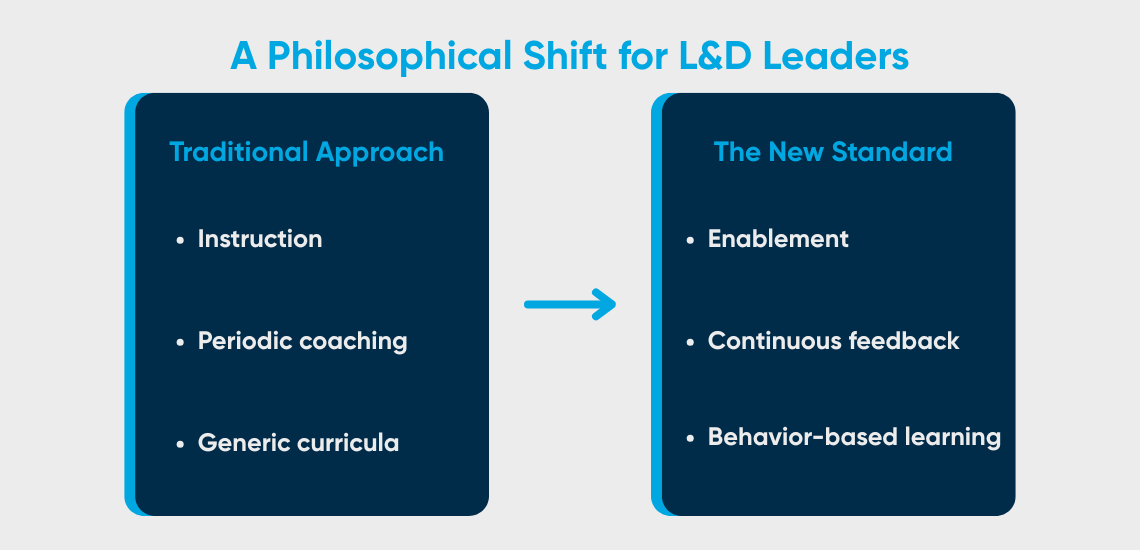
The result is not just better-trained employees, but more capable ones.
Time to Proficiency: Where AI Delivers Its First Breakthrough
Time to proficiency has always been one of the most expensive variables in contact center operations. Long ramp periods delay revenue contribution, increase early attrition, and put pressure on tenured staff to compensate.
AI dramatically compresses that curve. A Stanford and MIT study published by the National Bureau of Economic Research found that customer support agents with AI assistance reached the same performance level in two months that agents without AI took over six months to achieve (Brynjolfsson, Li, and Raymond, 2023).
By providing contextual guidance in real time, new hires no longer rely solely on recall under pressure. They are supported by systems that help them make better decisions faster without sacrificing compliance or customer experience.
In 2025, Qualfon published a special report highlighting a consistent pattern across organizations adopting AI: the fastest, most sustainable wins come from using AI behind the scenes first, supporting agents and operations before exposing AI directly to customers.
This approach is especially powerful in learning environments. When AI augments agents rather than replaces them, confidence builds quickly, errors decline, and proficiency stabilizes sooner.
The impact is faster speed to independence, lower error rates during ramp, and reduced early-stage attrition.
It’s important to note that none of this requires lowering performance standards. AI raises the floor and the ceiling at the same time.
Learning, Revenue, and the Shift to Higher-Value Work
One of the biggest misconceptions about AI is that its primary value lies in cost reduction. In reality, its most strategic benefit is role elevation.
As AI absorbs low-complexity, transactional tasks, human roles shift toward higher judgment, higher empathy, and higher business impact work. That shift fundamentally changes what Learning & Development must deliver.
Training is no longer about speed alone. It is about readiness for complexity.
AI-enabled learning environments support this transition by:
- Reinforcing best practices in real time
- Helping agents navigate nuanced customer scenarios
- Identifying skill gaps before they impact outcomes
- Supporting cross-sell, retention, and resolution quality
From a revenue perspective, this matters deeply. When agents are better equipped to handle complex interactions, they protect customer relationships, reduce churn, and uncover value opportunities that scripted environments often miss.
Learning becomes a growth lever, not a cost center.
A Case in Point: AI-Powered Training in Action
This case study demonstrates how intelligent learning tools can dramatically improve both performance and experience when deployed with intention.
Rather than replacing traditional training outright, AI was layered into the learning ecosystem: supporting agents during live interactions, accelerating feedback loops, and reducing dependency on post-call coaching alone.
The outcomes reflected a broader industry truth: performance improves fastest when learning is embedded, contextual, and continuous.
"For L&D leaders, this reinforces an important lesson. AI is most effective when it complements human coaching rather than competing with it. Trainers and leaders gain better visibility into performance drivers, while agents gain confidence and clarity in the moment."
Retention Is an Enablement Problem
Attrition in contact centers is often framed as an engagement issue. But in practice, it is frequently an enablement failure.
Employees leave when they feel overwhelmed, unsupported, or set up to fail.
AI-enabled learning directly addresses this challenge by reducing cognitive load and uncertainty. When agents know they have support—when answers are accessible, guidance is timely, and expectations are clear—they are more likely to stay, grow, and perform.
Equally important, AI changes how roles evolve. As highlighted in the above-mentioned special report, Breaking the Training Bottleneck: How AI is Revolutionizing Performance Development, AI does not eliminate jobs—it changes them. Learning & Development must evolve in parallel, preparing employees for more complex, more meaningful work rather than simply faster task execution.
"Retention improves when people see a future in the role, not just a script to follow."
Governance, Trust, and Responsible Learning Innovation
None of this works without governance.
AI in Learning & Development must be deployed responsibly—especially in regulated industries where data integrity, compliance, and customer trust are non-negotiable.
From an L&D standpoint, this means:
- Treating AI like another member of the workforce
- Monitoring performance, bias, and accuracy continuously
- Establishing clear ownership across Legal, IT, HR, and InfoSec
- Giving teams the ability to pause, adjust, and improve
Equally critical is trust at the frontline. AI adoption accelerates when employees understand how it helps them succeed, not how it monitors them. Involving frontline teams early builds confidence, improves design, and drives sustained adoption.
The New Role of Learning & Development Leaders
AI has elevated the expectations placed on Learning & Development. L&D leaders are no longer measured solely by training completion or certification rates. They are measured by speed, stability, and impact.
AI does not replace the human elements of learning; it amplifies them. Trainers become strategists. Coaches become analysts. Learning leaders become architects of performance ecosystems.
Looking Ahead
AI is no longer a question of if in Learning & Development. It is a question of how well.
Organizations that approach AI as a shortcut will struggle. Those that approach it as an enabler, grounded in governance, data readiness, and human-centered design, will build more resilient, capable workforces.
At Qualfon, our experience confirms what the data increasingly shows: learning embedded into the flow of work is the future. AI makes that possible at scale.
And for organizations navigating rising complexity, talent pressures, and customer expectations, that future cannot come soon enough.
About Qualfon
Qualfon is a global provider of omnichannel customer experience and business support solutions. From call center support to lead generation to ecommerce fulfillment, we support our clients and their customers throughout the customer journey.
Learn more about Qualfon’s Call Center Support, CX Innovation Solutions, and Back Office Support Services.
About the Author
Marvie Wright is a visionary learning executive and transformation leader with a passion for turning potential into performance. With over 10 years at Qualfon, she leads training, learning specialists, instructional design (including AI), SMEs, and admin teams—building ecosystems where innovation and excellence thrive.
Her accolades include 2021 Shining Star, Six Sigma Green Belt, John Maxwell Certified Coach & Trainer, and active membership in the executive network Chief. Recognized globally for impact, Marvie was named Analyst of the Year (CallMiner, 2018) for groundbreaking speech analytics innovation, and in 2025, her team earned Top 10 L&D Departments in the World (OnCon).
Known for her energy, clarity, and bold vision, Marvie is a powerful force at any table where learning, leadership, and innovation are on the menu.
Connect with Marvie on LinkedIn.
Sources:
National Bureau of Economic Research, “Generative AI at Work,” Erik Brynjolfsson, Danielle Li, and Lindsey R. Raymond (2023). Published in The Quarterly Journal of Economics, Vol. 140, Issue 2, 2025.
